order-notificationsmain
Checks are running
1 check in progress
Rootform review Running
For Terraform and OpenTofu
Rootform works out where your resources sit, what they connect to and why. Explore, compare, check.
curl -fsSL https://rootform.dev/install | sh 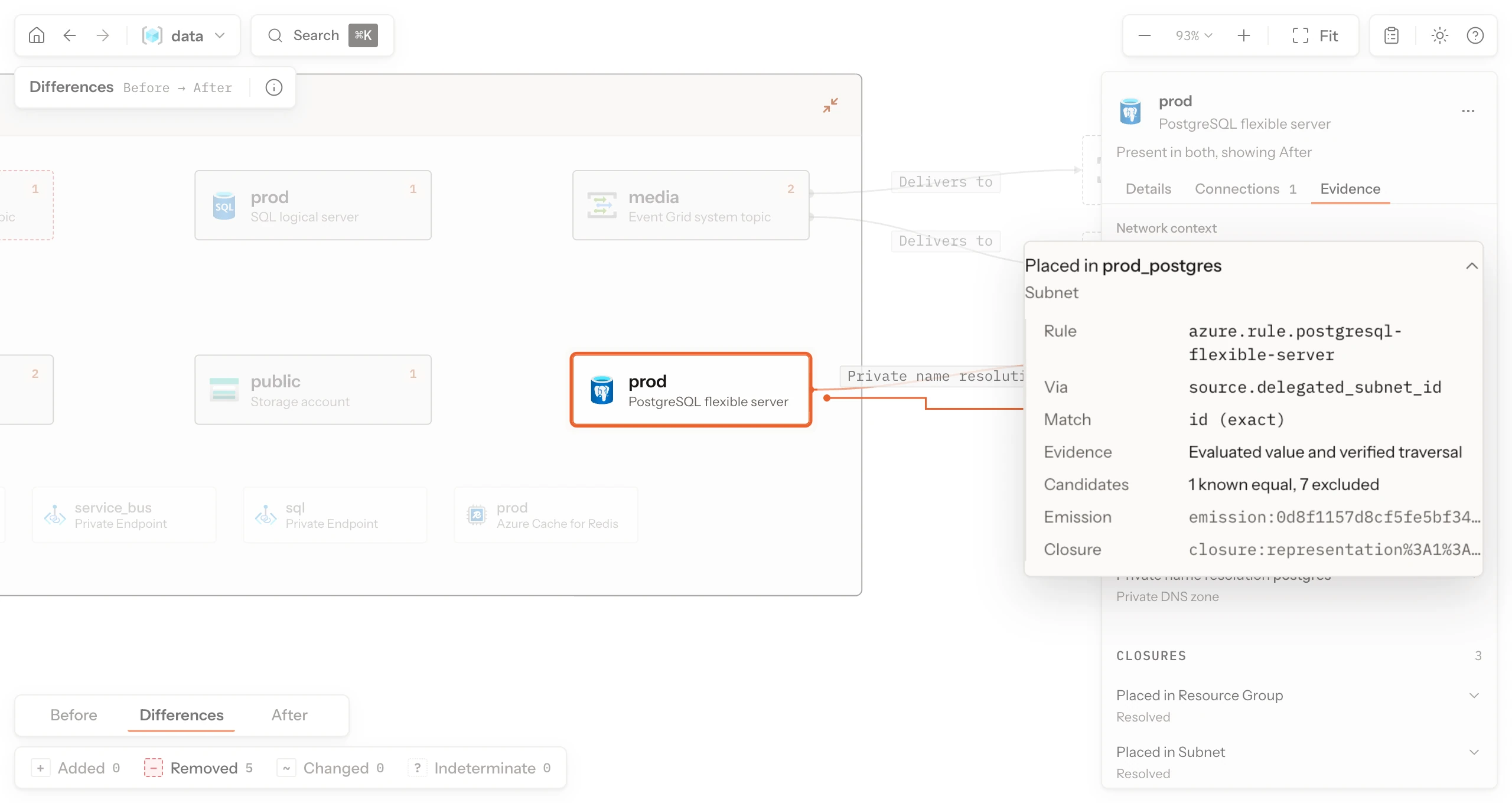
~/commerce-platform
$ rootform run base.json --diff head.json -o comparison.json
Loading    base.json (saved Form; no recompilation)
Loading    head.json (saved Form; no recompilation)
Comparing  Before Planned (base.json) -> After Planned (head.json)
Wrote      comparison.json
Inputs compared
[58 more lines]
Explorer
  http://127.0.0.1:21717/

  Press Ctrl+C to stop.
~/commerce-platform
$ rootform check comparison.json --policy-pack ./policies
Using baseline 0.1.0 from ./policies for this command only
Selected   2 Policies from 1 Policy Pack
Loading    comparison.json (saved Form; no recompilation)
Evaluating 2 Policies against Before (Planned) and After (Planned)
Policy check completed
[12 more lines]
Verdict          PASSED    PASSED

Overall verdict  PASSED
order-notificationsmain
Checks are running
1 check in progress
~/commerce-platform
$ rootform run base.json --diff head.json -o comparison.json
Loading    base.json (saved Form; no recompilation)
Loading    head.json (saved Form; no recompilation)
Comparing  Before Planned (base.json) -> After Planned (head.json)
Wrote      comparison.json
Inputs compared
[58 more lines]
Explorer
  http://127.0.0.1:21717/

  Press Ctrl+C to stop.
~/commerce-platform
$ rootform check comparison.json --policy-pack ./policies
Using baseline 0.1.0 from ./policies for this command only
Selected   2 Policies from 1 Policy Pack
Loading    comparison.json (saved Form; no recompilation)
Evaluating 2 Policies against Before (Planned) and After (Planned)
Policy check completed
[12 more lines]
Verdict          PASSED    PASSED

Overall verdict  PASSED
~/commerce-platform
$ rootform run base.json --diff head.json -o comparison.json
Loading    base.json (saved Form; no recompilation)
Loading    head.json (saved Form; no recompilation)
Comparing  Before Planned (base.json) -> After Planned (head.json)
Wrote      comparison.json
Inputs compared
[58 more lines]
Explorer
  http://127.0.0.1:21717/

  Press Ctrl+C to stop.
~/commerce-platform
$ rootform check comparison.json --policy-pack ./policies
Using baseline 0.1.0 from ./policies for this command only
Selected   2 Policies from 1 Policy Pack
Loading    comparison.json (saved Form; no recompilation)
Evaluating 2 Policies against Before (Planned) and After (Planned)
Policy check completed
[12 more lines]
Verdict          PASSED    PASSED

Overall verdict  PASSED
order-notificationsmain
Checks are running
1 check in progress
A plan shows resource changes. What they mean for the architecture, and for your team's rules, is still on you.
Once the cluster moves, what still reports to the prod workspace?
Plan excerpt: azurerm_kubernetes_cluster.prod will be updated in-place, its oms_agent log_analytics_workspace_id changing from the workspace log-commerce-prod to a value known after apply; azurerm_log_analytics_workspace.platform will be created. Plan: 2 to add, 2 to change, 4 to destroy.
 prodAKS cluster
 prodApplication Insights platformLog Analytics workspace prodLog Analytics workspace
Application Insights still reports to prod. It isn't changing, so the plan doesn't list it.
prodApplication Insights
Present in both, showing Planned
Observed by prodLog Analytics workspace
Local and read-only
No credentials, no state locks. It never executes a provider or calls your cloud.
Every fact cites its Rule
Placements and connections come from Rules, never from depends_on alone.
Nothing is guessed
What the evidence can't settle stays indeterminate, with the reason.
A Form you keep
One JSON file to reopen, compare or check later, without attribute values.
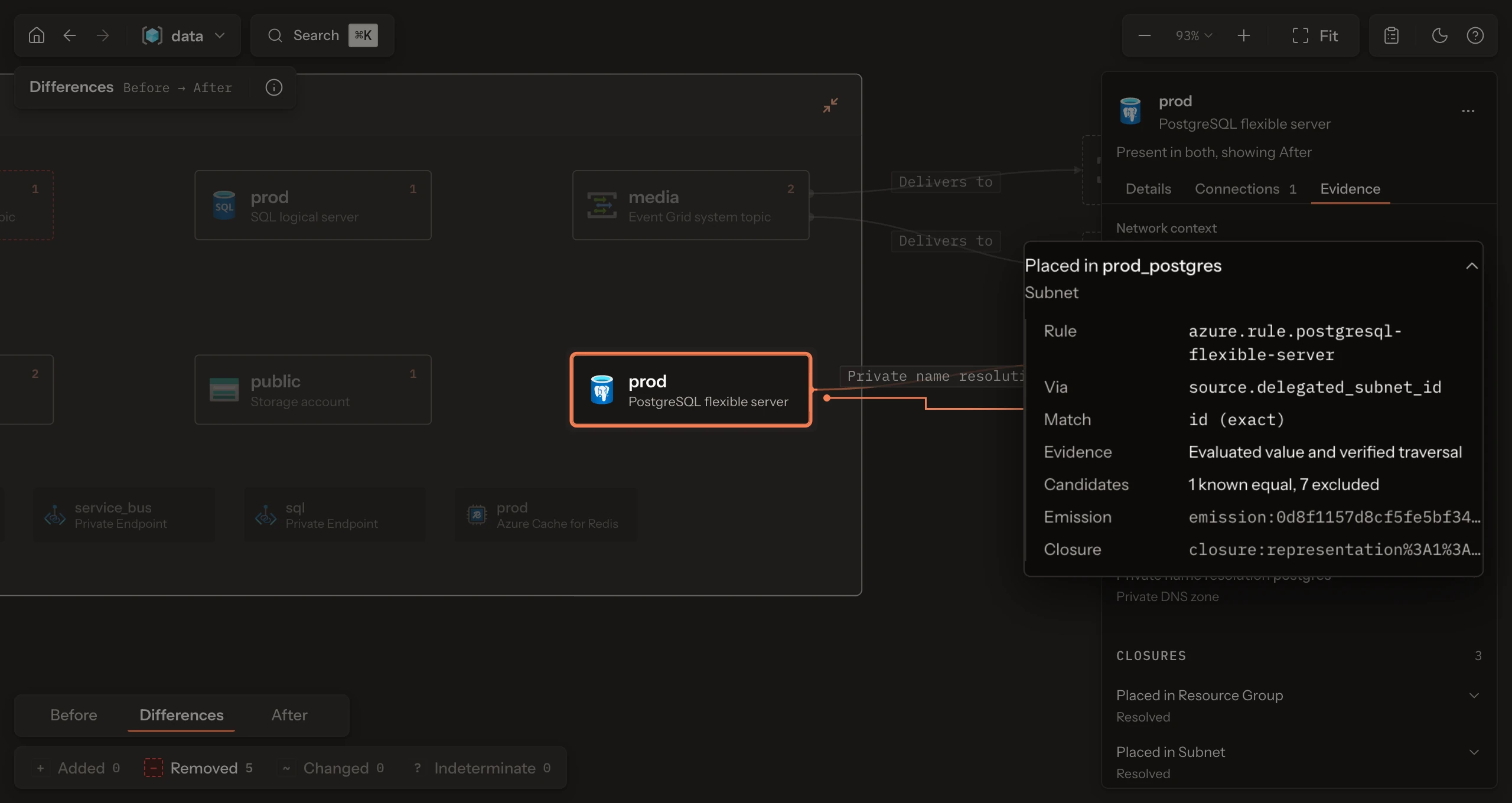
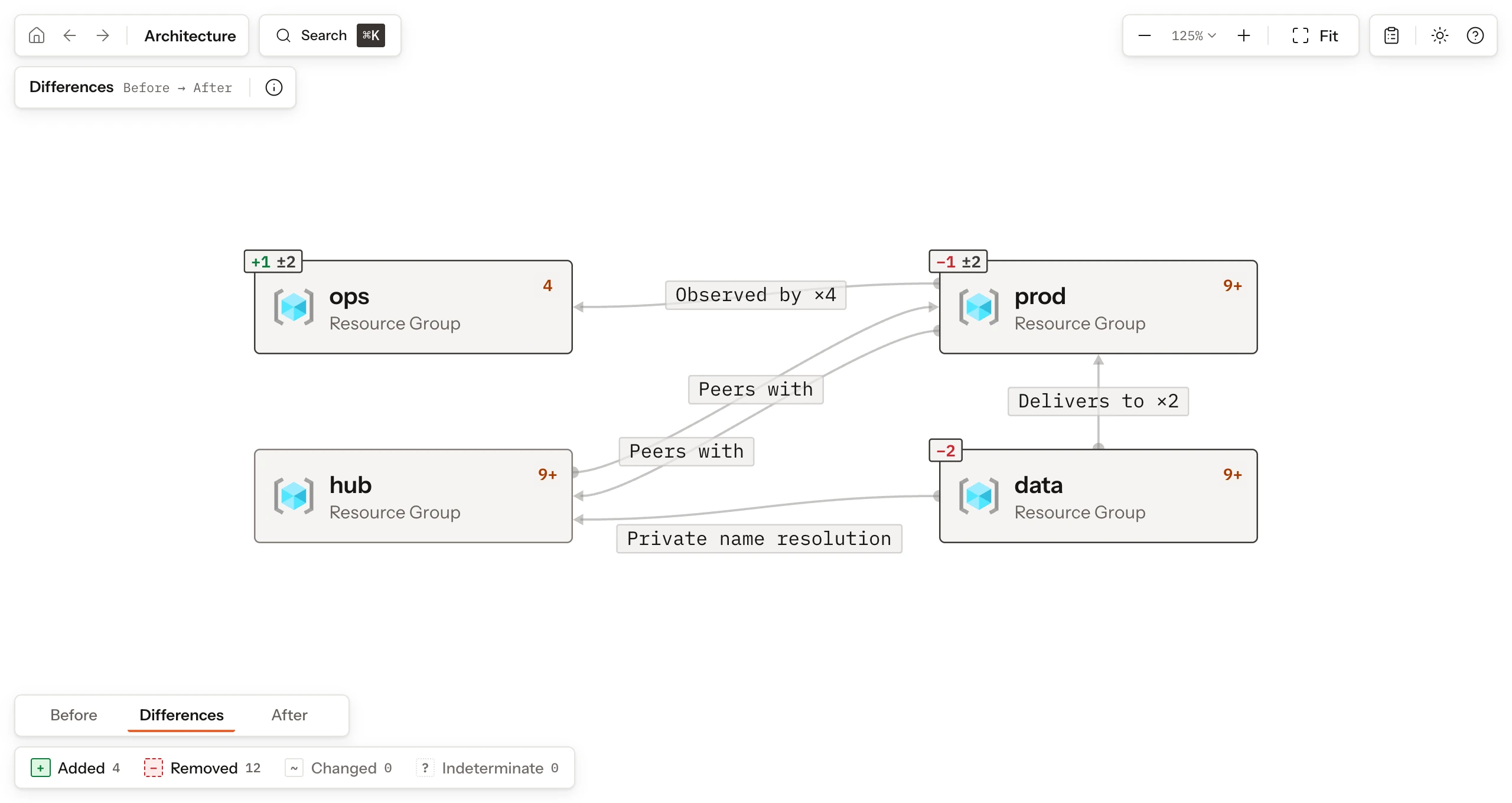
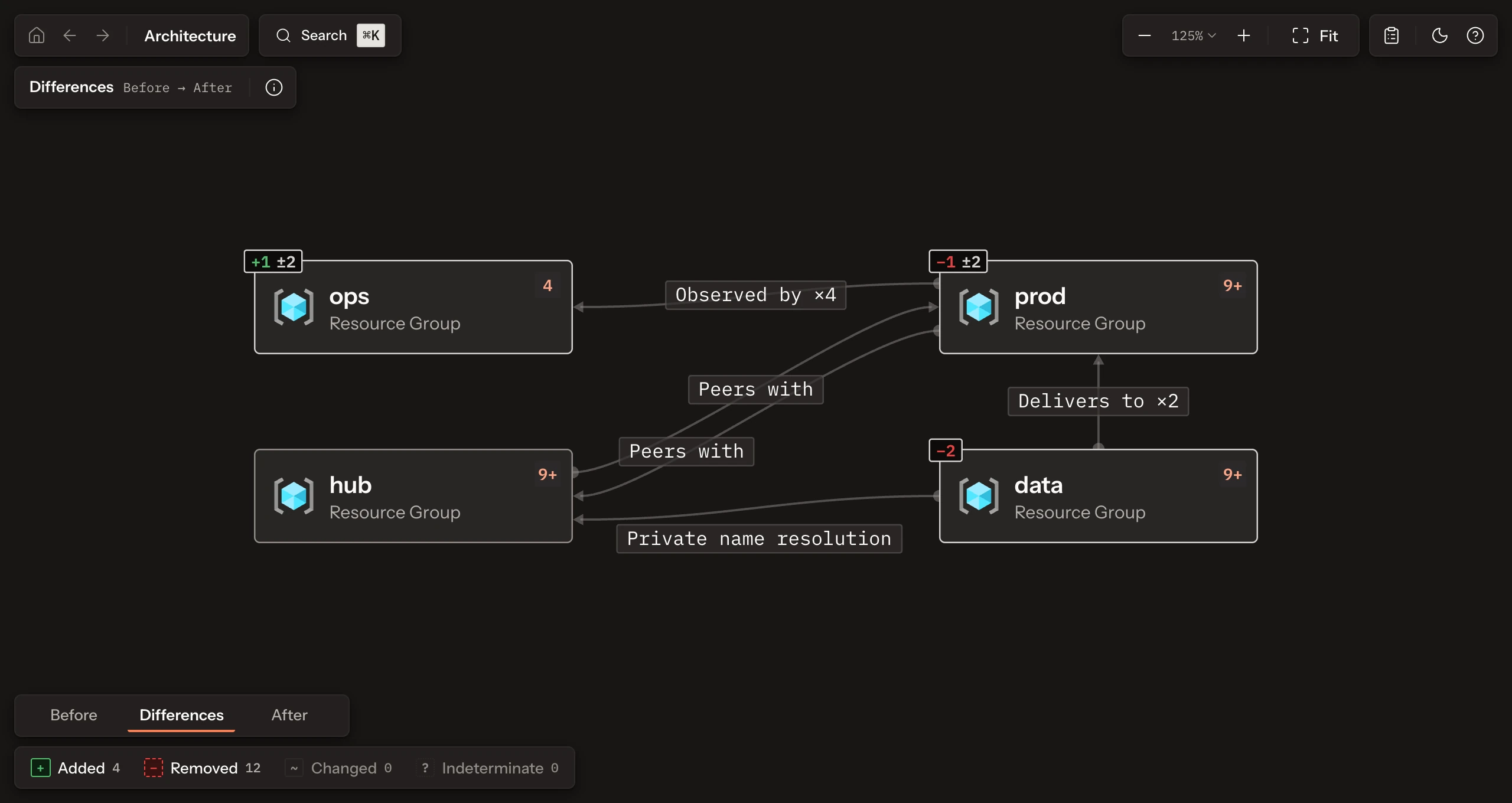
Pipe in a plan. Ask any resource where it sits, and why.
Given the same plan, Rootform writes the same Form, byte for byte, so your terminal, the Explorer and the pull request read the same facts.
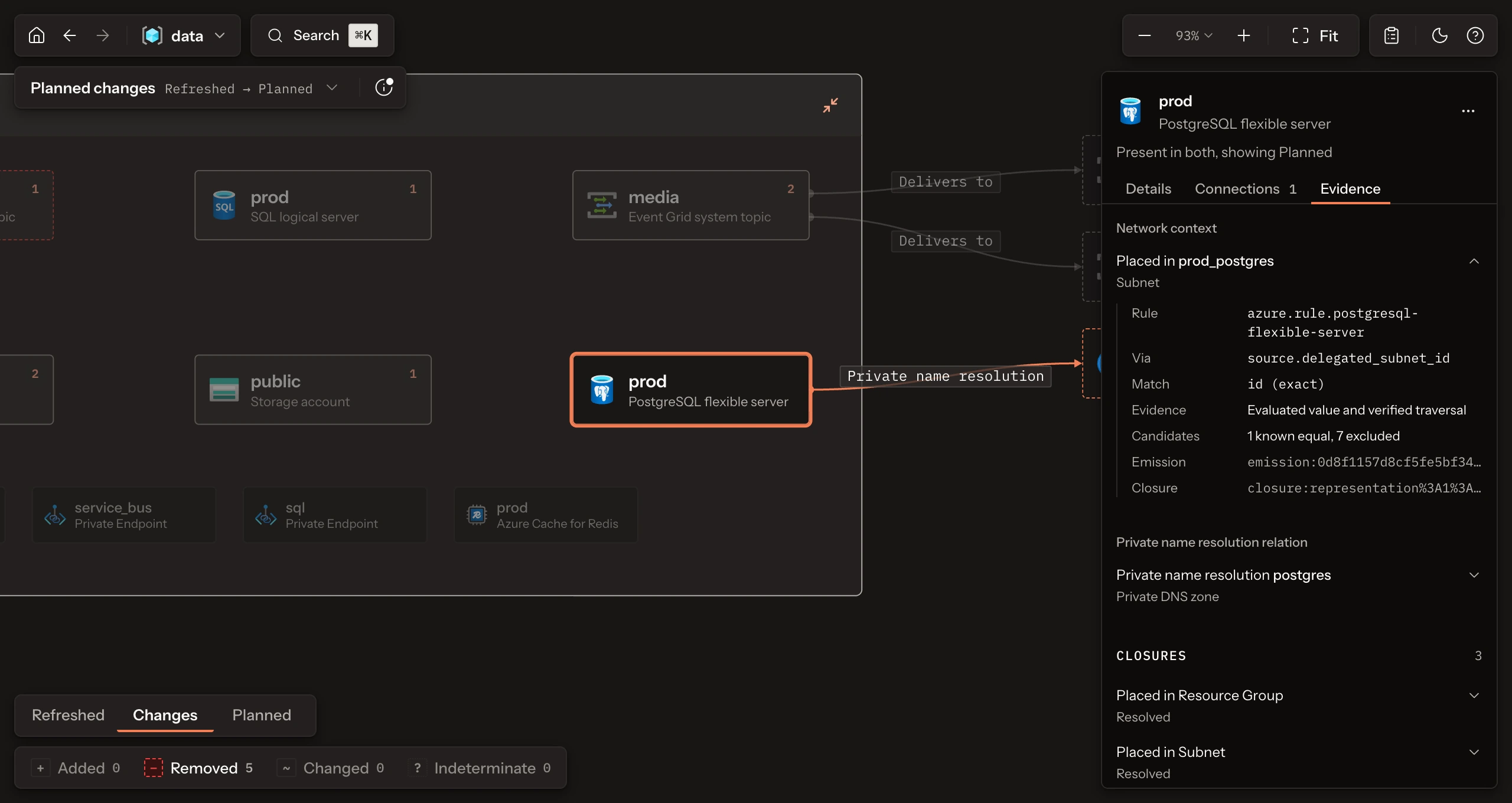
Explain an architecture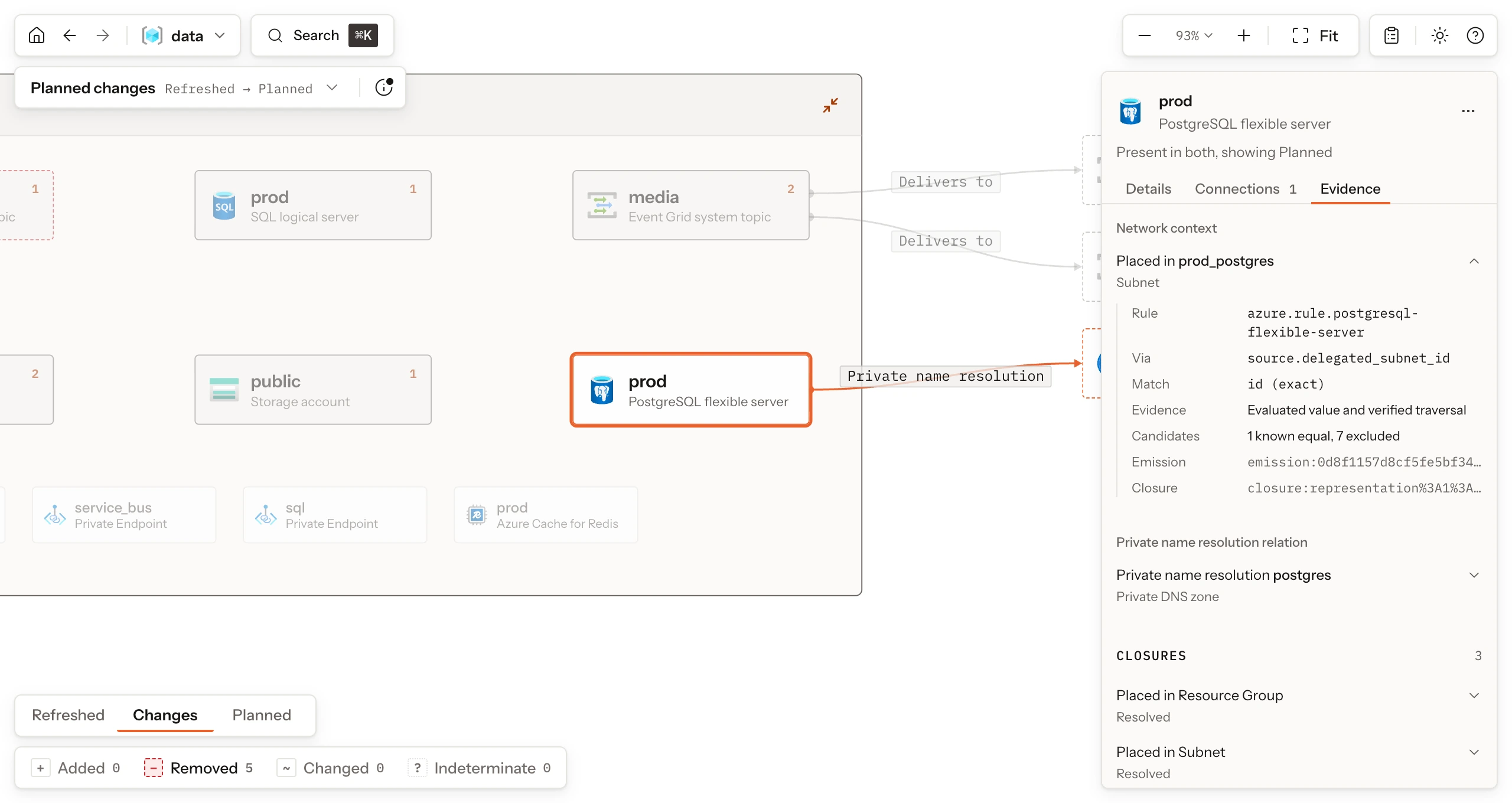
~/commerce-platform
$ terraform show -json plan.tfplan | rootform run - --plan-file plan.tfplan --no-serve -o form.json
Compiling  standard input (plan JSON)
Enriched   saved plan paired with this plan JSON (1 module)
Wrote      form.json
Plan analyzed
[7 more lines]
Architecture
  Instances      97
  Interpreted    97
  Relations      15
  Contexts       110
  Contributions  37

Planned changes
  Refreshed -> Planned

  Instances      1 added, 3 removed, 1 planned for replacement
  Relations      1 added, 2 removed
  Contexts       1 added, 5 removed
  Contributions  1 added, 1 removed
[48 more lines]
~/commerce-platform
$ rootform explain instance azurerm_postgresql_flexible_server.prod --input form.json
Loading    form.json (saved Form; no recompilation)
Instance explained

Input  form.json
Stage  Planned

azurerm_postgresql_flexible_server.prod
  Instance        managed instance of azurerm_postgresql_flexible_server; planned (no-op)
  Provider        registry.terraform.io/hashicorp/azurerm
  Interpretation  applied azure.rule.postgresql-flexible-server as managed-database
[19 more lines]
  Closures
    context network -> subnet
      via source.delegated_subnet_id, match exact by id
      resolved, 1 fact; candidates: 1 known equal, 0 unknown, 7 excluded

    relation private-name-resolution -> dns-zone
      via source.private_dns_zone_id, match exact by id
      resolved, 1 fact; candidates: 1 known equal, 0 unknown, 6 excluded
[4 more lines]
~/commerce-platform
$ rootform run form.json
Loading    form.json (saved Form; no recompilation)
Form loaded

Input              form.json
Form               Plan, saved by rootform 0.2.1
[69 more lines]
Explorer
  http://127.0.0.1:21717/

Press Ctrl+C to stop.~/commerce-platform
$ terraform show -json plan.tfplan | rootform run - --plan-file plan.tfplan --no-serve -o form.json
Compiling standard input (plan JSON)
Enriched saved plan paired with this plan JSON (1 module)
Wrote form.json
Plan analyzed
[7 more lines]
Architecture
Instances 97
Interpreted 97
Relations 15
Contexts 110
Contributions 37
Planned changes
Refreshed -> Planned
Instances 1 added, 3 removed, 1 planned for replacement
Relations 1 added, 2 removed
Contexts 1 added, 5 removed
Contributions 1 added, 1 removed
[48 more lines]
~/commerce-platform
$ rootform explain instance azurerm_postgresql_flexible_server.prod --input form.json
Loading form.json (saved Form; no recompilation)
Instance explained
Input form.json
Stage Planned
azurerm_postgresql_flexible_server.prod
Instance managed instance of azurerm_postgresql_flexible_server; planned (no-op)
Provider registry.terraform.io/hashicorp/azurerm
Interpretation applied azure.rule.postgresql-flexible-server as managed-database
[19 more lines]
Closures
context network -> subnet
via source.delegated_subnet_id, match exact by id
resolved, 1 fact; candidates: 1 known equal, 0 unknown, 7 excluded
relation private-name-resolution -> dns-zone
via source.private_dns_zone_id, match exact by id
resolved, 1 fact; candidates: 1 known equal, 0 unknown, 6 excluded
[4 more lines]
~/commerce-platform
$ rootform run form.json
Loading form.json (saved Form; no recompilation)
Form loaded
Input form.json
Form Plan, saved by rootform 0.2.1
[69 more lines]
Explorer
http://127.0.0.1:21717/
Press Ctrl+C to stop. Concepts let one file work across providers. Every verdict comes with its evidence.
27 Rules in seven Dialects map to this Concept.
policy "managed-database-network-context" {  target {    concept = rf.concept.managed-database  }
  assert = (    exists(contexts(rf.context.network, rf.concept.virtual-network)) ||    exists(contexts(rf.context.network, rf.concept.subnet))  )
  message = "Managed databases must belong to a network context."}
Target a Concept
One target reaches every type the Dialects map to it.
Assert on evidence
It passes only when the evidence places the database in a virtual network or a subnet.
Say what it requires
Reviewers read this requirement in the pull request.
policy "managed-database-network-context" {  target {    concept = rf.concept.managed-database  }
  assert = (    exists(contexts(rf.context.network, rf.concept.virtual-network)) ||    exists(contexts(rf.context.network, rf.concept.subnet))  )
  message = "Managed databases must belong to a network context."}
Target a Concept Lines 2–4
One target reaches every type the Dialects map to it.
27 Rules in seven Dialects map to this Concept.
Assert on evidence Lines 6–9
It passes only when the evidence places the database in a virtual network or a subnet.
Say what it requires Line 11
Reviewers read this requirement in the pull request.
PASSED exit0
The evidence proves the assertion.
VIOLATED exit1
The evidence proves it false.
INDETERMINATE exit3
The evidence can't decide. It never counts as a pass.
Check a plan, a state, or both sides of a comparison. Write a Policy Pack
One step after terraform plan.
GitLab, Azure Pipelines or any shell- run: terraform plan -out plan.tfplan- run: terraform show -json plan.tfplan > plan.json- uses: rootform-dev/action@v1 with: version: 0.3.0 input: plan.json plan-file: plan.tfplan policy-pack: ./policies comment: true
github-actionsbotcommented
Rootform
Policies
Verdict: PASSED
Planned architecture
2 Policies selected. 2 evaluations passed.
1 more Policy
Passed Policy details
baseline.
Requirement: Managed databases must belong to a network context.
Passed: 1 evaluation
azurerm_postgresql_flexible_server.: The network context toward subnet through source. (match exact by id) resolved to azurerm_subnet. (evidence: both).Read drift as architecture, and see what the plan puts back.
Your plan already holds three moments. Rootform compares each pair, so drift the plan reverts cancels out of the net change and reviewers see only what remains.
How comparisons workRecorded
What the state recorded, before refresh.
Refreshed
What refresh found. The plan starts from here.
Planned
What the plan proposes, before anything is applied.
~/restored-drift
$ terraform show -json plan.tfplan | rootform run -
Compiling  standard input (plan JSON)
Plan analyzed
[21 more lines]
Reported drift
  Recorded -> Refreshed
  The export does not establish the refresh scope.

  Drift entries  1 (1 architectural)
  Effect         1 fact added, 1 removed

  ~ aws_kms_alias.app  changes the architecture; 2 fact changes
~/restored-drift
$ terraform show -json plan.tfplan | rootform run -
Compiling  standard input (plan JSON)
Plan analyzed
[11 more lines]
Planned changes
  Refreshed -> Planned

  Contributions           1 added, 1 removed
  Indeterminate closures  0

  Contributions
    + aws_kms_alias.app  contribution -> aws_kms_key.primary  added
- aws_kms_alias.app contribution -> aws_kms_key.standby removed~/restored-drift
$ terraform show -json plan.tfplan | rootform run -
Compiling standard input (plan JSON)
Plan analyzed
[30 more lines]
Net change
Recorded -> Planned
No net architectural difference: the plan proposes to restore 2 drift fact
changes.
Cancelled
= aws_kms_alias.app removed by drift, planned for restoration
contribution -> aws_kms_key.primary
= aws_kms_alias.app added by drift, planned for removal
contribution -> aws_kms_key.standby~/restored-drift $ terraform show -json plan.tfplan | rootform run - Compiling standard input (plan JSON) Plan analyzed [21 more lines] Reported drift Recorded -> Refreshed The export does not establish the refresh scope. Drift entries 1 (1 architectural) Effect 1 fact added, 1 removed ~ aws_kms_alias.app changes the architecture; 2 fact changes
~/restored-drift
$ terraform show -json plan.tfplan | rootform run -
Compiling  standard input (plan JSON)
Plan analyzed
[21 more lines]
Reported drift
  Recorded -> Refreshed
  The export does not establish the refresh scope.

  Drift entries  1 (1 architectural)
  Effect         1 fact added, 1 removed

  ~ aws_kms_alias.app  changes the architecture; 2 fact changes
~/restored-drift
$ terraform show -json plan.tfplan | rootform run -
Compiling  standard input (plan JSON)
Plan analyzed
[11 more lines]
Planned changes
  Refreshed -> Planned

  Contributions           1 added, 1 removed
  Indeterminate closures  0

  Contributions
    + aws_kms_alias.app  contribution -> aws_kms_key.primary  added
- aws_kms_alias.app contribution -> aws_kms_key.standby removed~/restored-drift
$ terraform show -json plan.tfplan | rootform run -
Compiling standard input (plan JSON)
Plan analyzed
[30 more lines]
Net change
Recorded -> Planned
No net architectural difference: the plan proposes to restore 2 drift fact
changes.
Cancelled
= aws_kms_alias.app removed by drift, planned for restoration
contribution -> aws_kms_key.primary
= aws_kms_alias.app added by drift, planned for removal
contribution -> aws_kms_key.standby~/restored-drift $ terraform show -json plan.tfplan | rootform run - Compiling standard input (plan JSON) Plan analyzed [21 more lines] Reported drift Recorded -> Refreshed The export does not establish the refresh scope. Drift entries 1 (1 architectural) Effect 1 fact added, 1 removed ~ aws_kms_alias.app changes the architecture; 2 fact changes
From AWS to Vault, every Rule is plain .rf.hcl you can read, extend or replace.
The official Dialects ship inside the binary and work without setup. A Form records the exact Rules it used, so reopening it later never reinterprets it with newer ones.
Another question? Ask the community
A Terraform or OpenTofu plan or state JSON export. For plans, pairing the saved plan gives Rootform the strongest evidence.
No. Rootform analyzes it where you run it, with no telemetry. It never runs Terraform or contacts your cloud, and the Form does not retain attribute values. In CI, the Action's artifact keeps the Form and its reports, never the raw plan or state.
No. Keep producing plans and state as you already do. Rootform reads the exported result and fits alongside your existing local and CI workflows.
A dependency graph shows references. Rootform derives architectural placements and connections through Dialect Rules, and keeps the evidence behind each fact. What it can't establish stays indeterminate.
Yes. No account is required. The CLI, Explorer, Policy checks and GitHub Action are free and will remain free. Rootform Cloud is also in preparation as an optional hosted offering.
Install Rootform, point it at a plan, and read what it builds.
# Install on Linux
curl -fsSL https://rootform.dev/install | sh # Verify
rootform version